Sunday, 17 May 2015

DOLPHIN FACTS

DOLPHIN FACTS

Top Facts about Dolphins

There is no doubt that dolphins are one of the most interesting forms of aquatic life out there. They are easy to recognize and you likely already know they are very smart. Yet there are plenty of great facts about them that you may not know. That will all change though when you get done reading this!
  • The dolphin is the only mammal that gives birth with the tail first instead of the head.
  • Dolphins don’t smell very well.
  • Young dolphins will remain with their mother for a period of 2 or 3 years.
  • There are two stomachs for dolphins just like for cows. The first one stores the food for them and the second one is where digestion takes place.
  • A dolphin may be able to dive up to 1,000 feet.
  • The dorsal fin on every dolphin is very unique and it can be used to identify them from each other.
  • Dolphins can swim at a speed of up to 25 miles per hour for a long time. This is about 3 times faster than the fastest humans in the world.
  • The average lifespan of a dolphin is 17 years. However, some of them that have been observed in the wild lived about 50 years.
  • Most species of dolphins live in saltwater but some of them thrive in freshwater.
  • A dolphin needs to get air at different intervals. Some need air every 20 seconds but others only need it every 30 minutes.
  • A group of dolphins is called a pod.
  • The bonds of dolphins in a pod are very intense. They have been observed carrying for the sick, the elderly, and those that have been injured with great care.
  • Even though they are usually very mild tempered, dolphins can be aggressive.
  • They are able to see well in the water due to the retina gathering light in a unique way.
  • The brain of a dolphin is #2 is terms of size compared to its body size. It is only behind the human.
  • It is possible for a mature dolphin to eat up to 30 pounds of fish daily.
  • There are about 100 teeth in the mouth of a dolphin. They use the teeth to grab their prey but they don’t chew it. All food is swallowed whole.
  • Up to 20 feet in the air is the distance that a dolphin can leap.
  • The Killer Whale is the largest member of the dolphin family. They can be up to 30 feet in length.
  • The skin of the dolphin is very delicate and it can easily be damaged by contact with other surfaces.
  • The Boto is the largest of the dolphins that can live in freshwater. They can be up to 10 feet long.
  • Dolphins often use a hunting tactic of circling the fish in a school so that they make a tight ball. Then they will take turns going through the center of the ball to feed as they do so.
  • Only one side of the dolphin’s brain sleeps at a time. This allows them to be able to breathe and to be able to watch for threats even while they are resting.
  • Dolphins enjoy socializing and playing. They play with seaweed or with other members of the pod. Sometimes, they will tease other living creatures in the water.
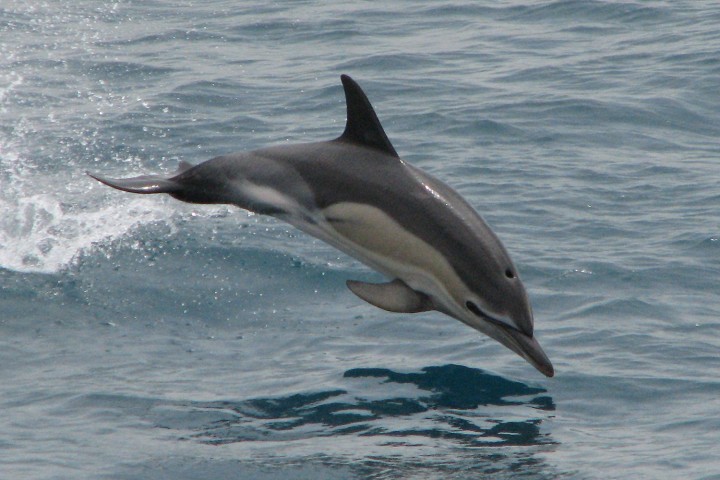
  • Global warming continues to be a problem for dolphins as it has reduced their food supply significantly.Dolphins Swimming in the Ocean
  • Dolphins can be migrational for food and to get to bodies of water that are the right temperatures for them. Not all pods of dolphins will migrate though if their needs are being met right where they are.
  • Dolphins are known to engage in a variety of different feeding methods in order to be successful.
  • Most of them involved cooperation and being in sync with other pod members. It is very rarely that they will try to get food on their own.
  • The smallest dolphins are about 4 feet long with the longest being 30 feet long. They can weigh from 90 pounds to more than 11 tons.
  • The fluke is the name for the tail on a dolphin.
  • Echolocation is a big part of overall communication for dolphins. It occurs through the melon in the head.
  • All dolphins have a blowhole at the top where they take in air when they come to the surface.
  • Almost all dolphins have no hair other than a few that they have at birth. Only the Boto River Dolphin has a small amount of hair that they will keep as an adult.
  • They have a fast healing process for their bodies even when they have deep wounds such as those that are the result of shark bites. Experts haven’t been able to determine how this is possible for dolphins when other mammals would hemorrhage.

 However, some have been documented to live to the age of 50!


AMAZON RIVER DOLPHIN

AMAZON RIVER DOLPHIN

Amazon River Dolphin Facts

Introduction


You will often hear the Amazon River Dolphin referred to as the Boto Dolphin. This is one of the river dolphins found in the world. Due to the mystifying appearance of it, many legends in the culture of the Amazon include them. Some of these stories suggest that the dolphins are really handsome men that will seduce young women that come to the water.

Description

The body shape of the Amazon River Dolphin is very unique and that makes it easy to tell them apart from other species. They have a body that is long and filled out. They have fins that are shaped like paddles with a ridge on their back instead of a dorsal fin. They also have a bulging forehead which is called the melon. The eyes are small and they have chubby looking cheeks. The beak is very long and they can have as many as 140 teeth.

The color of this dolphin ranges from a bluish gray color to white. They can also be pink which is very interesting indeed. They have flexible necks because not all of the vertebrae in their necks are fused. This gives them the ability to move their head in various directions. They are the largest of all the river dolphins. The males can be just over 8 feet with the females around 7 feet long. The males can weigh up to 400 pounds with the females around 330 pounds.

What is very interesting is that in spite of such a heavy body, they are able to move with ease and not use a great deal of energy to do so. They have very broad flukes that are triangular shaped. They don’t swim fast but they are efficient in their movements. They have lots of trees and other elements in their habitat to maneuver around and they have no trouble doing so.

Distribution

The Amazon River Dolphin lives around the basins where the Amazon River and Orinoco River drains. Both of these rivers are found in South America. They are known to be found around many areas including Columbia, Bolivia, Venezuela, Guyana, Ecuador, and Peru. They can live up to 1,865 miles from the shore!
They have an overall distribution that covers close to 7 million square kilometers. They do have limits in their environment including marine waters, rapids that are impossible for them to pass, waterfalls, and even some areas of these rivers that are simply too shallow for them to successful get through.
What is very interesting is that the Amazon River Dolphin can survive in plenty of different types of micro habitats. For example, they do well in the mouth of a river, in a lake, below waterfalls, in small channels, and around main rivers. As long as the water temperature is warm enough and they have food, they should be able to do just fine.
For this species of dolphin, one of the significant influences of where they will reside though is the amount of water in terms of how high it is. During various times of the year, the water levels will drop too low in certain areas which triggers migration for the Amazon River Dolphin.

Behavior

These dolphins may live in pods that only contain 2 members. Others are small pods with about 15 members. They aren’t as social as other species of dolphins so the larger groups aren’t often seen. They prefer to keep them at lower numbers. They form strong bonds within their pod and they seem to be the most active early in the morning as well as again later in the evening.

They don’t swim fast but they are still very playful as well as quite curious. They tend to get very close to the boats in the water to explore them.Sometimes, they will interact with other species of dolphins. They have been seen taking part in lob tailing, waving flippers, and rolling. They aren’t deep divers so they are frequently seen at the surface of the water. It is seldom that you will see them with the flukes out of the water.
They are very playful and they have been seen pulling at grass under the water, playing with logs, and even playing with other forms of aquatic life in the water such as turtles and fish. The flexibility of their bodies allows the Amazon River Dolphin to swim through some very tight areas. They can also swim upside down if they need to. Some experts believe this is to allow them better vision as their chubby cheeks could make seeing downward hard in the water when they are upright.

Feeding

Fish make up the majority of the feeding for the Amazon River Dolphin, and there are at least 50 types of fish they can dine on. They are highly dependent on the health of the fish populations for their own survival. They have been known to also consume crabs and turtles when their normal food supply isn’t enough. Almost all of their feeding efforts take place in the shallow areas of the water.
Since they live in much smaller groups, reliance on group feeding isn’t common with this dolphin. Instead, they tend to do their own hunting early in the morning and then again later at night. They consume approximately 2.5% of their own body weight daily in food. This is about half of the average body weight of consumption for other species of dolphins.
Part of their strategy to get food is to hang out around waterfalls and mouth areas of the river. This is where there are disruptions for the schools of fish and that makes them much easier for the Amazon River Dolphin to capture.

Reproduction

Females are ready to mate before males, around 6 to 10 years of age. Males are ready to mate between 7 and 12 years of age. It takes about 11 months for the young calves to be born after mating. The birthing time is usually in July as the water levels are decreasing and the fish are moving into the major water areas. The timeframe between births can be up to 5 years for the Amazon River Dolphin. They are known to be able to survive in the wild for up to 30 years.

Conservation Status and Threats

The Amazon River Dolphin continues to be threatened due to pollutants in the water. Not only do they make it very hard for the dolphins to survive, it also depletes the rivers of the food sources they need to get enough to eat. In some of these rivers, the implementation of hydroelectricity and irrigation have isolated the dolphins into segregated areas of habitat. They don’t have the ability to migrate when water levels are too low or when there isn’t enough food for survival in a given location.
In Bolivia and Brazil, these dolphins are fully protected by the law. There are some efforts on International levels in place to offer them the same protection in Venezuela, Peru, and Columbia. The fact that so many tourists come to see the pinkish colored dolphins is also a reason for some to take part in preserving them in order to keep people coming back to see them.


Sunday, 3 May 2015

Killer whales, also known as Orcas

Top Facts about Killer Whales


killer whale factsKiller whales, also known as Orcas (Orcinus orca) are fascinating creatures that attract a great deal of attention from marine biologists, as well as the general public.

killer whale factsKiller whales, also known as Orcas (Orcinus orca) are fascinating creatures that attract a great deal of attention from marine biologists, as well as the general public.

Here are the top facts that make this cetacean so unique to the general public as well as to the scientists.

Here are the top facts that make this cetacean so unique to the general public as well as to the scientists.

  • Killer Whales are one of the fastest creatures in the sea, traveling up to 30 miles per hour.
  • Killer Whales are able to control the flow of blood to their hearts and brains, which keeps them from suffering from a lack of oxygen when they are deep underwater.
  • Killer Whales eat up to 5% of their body weight each day. This averages out to over 500 pounds of food for each Orca.
  • Killer Whales do most of their socialization within their own pods. 
  • Killer Whales are called “Killer Whales” because they feed on other dolphins and smaller whales, not because they kill people. They are also know as orcas.
  • The only recorded instances of a killer whale attacking a human being have been of attacks by Orcas held in captivity. No killer whale that lives in the wilds has ever attacked a human being.
  • Killer Whales eat up to 5% of their body weight each day. This averages out to over 500 pounds of food”.
  • Every Killer Whale has a mark behind it’s dorsal fin that is totally unique. These marks are used by humans to distinguish one killer whale from another, just as humans each have their own specific characteristics that make our appearances different from every one else’s.
  • Killer Whales use vocalization to communicate with each other, but each pod has it’s own unique ‘accent,’ which makes it easy for Orcas to identify members of their own pods.
  • Pods of killer whales are found in all oceans in the world, but the greatest numbers are found in cooler waters.
  • Killer Whales are actually dolphins. In fact, they are the largest dolphins in existence, and can be up to 30 feet or more in length, and weigh up to 12,000 pounds.
  • Killer Whale brain is five times larger than a humans. They are very social, intelligent, and curious. killer whales brains that have been studied with microscopes have proven to be as structured and developed as the human brain.
  • Killer Whales have very organized and complex social structures, and divide themselves in pods, which operate as human families do. They protect their young, ill, and injured within their pods.
  • Killer Whales spend 60% of their time foraging for food. killer whales do not migrate, but they have been known to travel hundreds of miles to find fresh food that is in ‘season.’
  • Life expectancy of a Killer Whale in the wild is 50 – 60 years for males, and up to 90 years for females, however, Killer Whales held in captivity have not lived longer than 30 yearsand the average life expectancy for captive Orcas is only 20 years.
  • Female Killer whales usually do not breed until they are between the ages of 12 and 16 years old. Their gestation period is 15 – 17 months, as opposed to 9 months for humans. They nurse their calves for up to 2 years. On an average, each female Orca that lives in the wilds will have approximately five calves during her lifetime.


Sunday, 19 April 2015

DUSKY DOLPHIN

DUSKY DOLPHIN

Dusky Dolphin Facts

Introduction


The Dusky Dolphin is very closely related to the Pacific White Sided Dolphin. 

However, the scientific studies conducted show that there are enough variations for them to be classified as two separate species. What you may not know is that their name was originally going to be Fitzroy’s Dolphin which was given to them by Charles Darwin.

Description

This is a small dolphin species and it is simple enough to identify it from other species out there. This is due to the head that is evenly sloped. It also lacks a beak at the end of the snout. They feature a bluish black color on the tail and along the back. They also have a dark band that is featured from the flanks to the tail diagonally. The belly is white with a dark color for the lower jaw and snout. They have gray from the eye to the flipper and then two white or cream stripes that run between the dorsal fin to the tail.

They are about 6 to 6 ½ feet long. They weigh from 150 to 187 pounds. The males and the females look very similar in size. The male does have a dorsal fin that is more curved than the females.


There are teeth found in both the upper and the lower jaws. They may have from 24 to 36 pairs of teeth that are very small and pointed. Usually, the upper jaw will have 2 sets less than what is found in the lower jaw.

Distribution


The Dusky Dolphin resides in the coastal waters of the Southern Hemisphere. The best known locations for them include New Zealand, the Southern region of Australia, The Southwest area of Africa, and in Tasmania. There are small populations of this dolphin living along the Western coast of South America.

They are coastal and can be located around both the slopes and the continental shelves. They stick to the warmer regions, but from time to time they have been found living in cooler temperatures as well.

Behavior


The Dusky Dolphin is very social, and their pods can be more than 1,000 members. However, it is more common to find them in much smaller numbers. They typically will range from 20 to 500 members. It is believed that the larger numbers come together for feeding and that there are plenty of subgroups within a larger pod. This allows a level of hierarchy to work for them that can be difficult for observations to fully identify.

They are very acrobatic and can be seen leaping out of the water. They are known to tumble in the air. They are also commonly found approaching boats so that they can bow ride. Playing and leaping are types of activities they often take part in as they socialize. They can swim very fast too. Communication includes the use of squeals, clicks, whistles, and squeaks. They are loud sounds and can be heard almost 2 miles away when they occur while the dolphins are out of the water.

Feeding


There are plenty of types of food that the Dusky Dolphin feeds upon. They include shrimp, squid, various fish, and anchovy. They can feed during the day or at night, and generally do so in highly sophisticated collaborative efforts. They are able to feed both at the surface of the water and at the bottom of it which gives them plenty of opportunities.

They tend to take part in efforts that involve up to 300 dolphins working as a team to successfully herd larger schools of fish. What is very interesting though is that they can change their strategies for foraging to fit the circumstances. Their communication each other is key to making sure they are able to get enough food for survival.

Reproduction

Spring is the time of year when the Dusky Dolphin is most likely to take part in mating. It takes about 11 months for the calf to be born. The males compete aggressively with each other in order to be able to mate with the females. There seems to be less involved with mating rituals with this species than with other dolphins. However, the bonds that do form seem to be apparent within a pod.

The age for matting seems to vary in different locations. It is believed that it could be determined based on food resources, stress, the length of the dolphin, and more. There needs to be additional research conducted to back up such theories. The females and their young will form nursery groups and they tend to stay in the water that is shallow so that they can rest.

The young will be fully weaned at about 18 months from the milk the mother produces. However, about 6 to 8 months of age they will be introduced to other food resources. They will be taught how to successfully hunt so that they can one day take care of their needs by contributing to the collaborative hunting efforts.

Conservation Status and Threats


It has been difficult to get a good count on the number of Dusky Dolphins in the wild. However, it is believed that they do endure huge losses of numbers due to getting tangled up with fishing nets or illegal harpoon hunting. Efforts to help with improving fishing methods has proved to be helpful. In Peru there is a huge demand for the meat of this dolphin and efforts to stop illegal killing can be difficult to implement even though it has been banned since 1996.

Some have been worried about the volumes of tourists that come to watch the dolphins around New Zealand. However, the experts don’t feel that this process has caused any major stress factors for the Dusky Dolphins to contend with. Studies that will help to identify environmental problems as well as to get a better count on the number of them are in progress. Right now, they aren’t in serious danger but hopefully conservation steps will also prevent their numbers from ever dropping low enough for them to be at risk of extinction.


Saturday, 18 April 2015

Commerson's Dolphin

Commerson's Dolphin

Commerson's Dolphin Facts

Introduction

There are quite a few different names that the Commerson's Dolphin is known by. They include the Panda Dolphin, Skunk Dolphin, and the Piebald Dolphin. However, the rightful name for them is the results of the Philbert Commerson's who saw them in 1767 in the strait of Magellan and shared his information.

Description 

The size of this dolphin can be very different based on location. Some them are just shy of 4 feet long and others are a bit over 5 1/2 feet. They can weigh as much as 190 pounds. What is very interesting with this species of dolphin is that the females are usually a bit larger than the males. They body of the Commerson’s Dolphin is very round, but it is also tapered at the ends. This enables them to have a body designed to swim fast but also to conserve energy as they do so.

Their body is designed for swimming. They have pectoral fins that are short and they are well supported by connective tissues. They also have control over blood circulation through the pectoral flippers. This is believed to assist them with maintaining the right body temperature.

They have a very interesting coloration pattern to them which is black and white. This serves to offer them camouflage in the water. The coloring can also make it possible for males and females to be distinguished from each other. The males have a patch on their belly that is oval shaped. For females, this same patch is going to be in the shape of a V.

There are 29 or 30 teeth located on each side of the jaw, both up and down. As a result, the Commerson’s Dolphin will have either 116 or 120 teeth total.

Distribution

There are two main locations where you will find this dolphin living. The largest of the two populations is around the inlets of Argentina and into the Strait of Magellan close to Falkland Islands. The other population is around the Kerguelen Islands and it wasn’t discovered until the 1950s. They tend to spend most of their time in the shallow water areas. They are found around harbors, rivers, and bays too. It is rare for them to be found at depths of more than 650 feet.

Behavior


This dolphin species is believed to be very migrational. It is believed they follow the fish in the winter time that are moving to warmer waters. The Commerson’s Dolphin is very active and they swim a great deal of the time. They are often frequently seen leaping from the water. They can do a variety of acrobatics including spins, twists, and they will bow ride behind boats in the water at fast speeds.

What is very interesting is that they have even been spotted swimming upside down. It is possible that they do so in order to survey their prey possibilities in given surroundings. Since they are rarely able to be observed much other than when they surface, there isn’t much well known about their behaviors.

Feeding

Even though most of the feeding efforts are collaborative, from time to time they have been seen feeding on their own. They use various types of herding methods as a team to get schools of fish to ball up and then they can dive in and consume them. These feeding efforts usually involve smaller groups of about 15 members. Since they can swim so quickly, they are able to get food and make it look virtually effortless.

Their diet consists of small fish, shrimp, octopus, squid, marine worms, and from time to time algae. They have one of the most diverse diets of all species of dolphins. What they will consume depends on their environment, the time of year, and the amount of food available compared to the number of Commerson’s Dolphins. They are opportunistic so they will feed on what they can find in order to survive.

They are known to get food from the open water surfaces as well as from the bottom of the sea floor. No species of dolphin chews their food, instead they swallow it whole so what they get has to be small enough to do so. They will consume about 10% of their body weight daily. This is about twice as much food as most species of dolphins consume when compared to their body weight.

Reproduction


There isn’t very much information known about reproduction for the Commerson’s Dolphin. The age of maturity can range from 5 to 9 years, with the females ready for mating before the males in the same habitat. Mating can occur from September through February. When it will occur depends on their location. It takes 12 months after mating for the young to arrive, and it will be a single calf born in the winter tail first.

The young will drink milk from the mother’s body for a period of time, but it isn’t determined when they are weaned. With other species of dolphins it is generally between 12 and 18 months of age. In the wild, the Commerson’s Dolphin has a lifespan of about 10 years. In captivity the average is 18 years.


Conservation Status and Threats


The last survey conducted in 1984 estimated at least 3,400 of them in the Strait of Magellan. However, it isn’t known what the overall population is for them today. Even so, there are efforts in place to help ensure that they don’t see depleted number and end up vulnerable or extinct. They are red listed as a threatened species.

Such conservation efforts have focused on reducing pollution, reducing the risk of the Commerson’s Dolphin getting caught up in commercial fishing nets, and reducing issues with noise around them which can increase their overall stress levels. Other efforts focus on reducing the threat of these dolphins being hunted for their meat and oil. They have also been hunted to use as bait for crab capture. However, enforcing laws to prevent such hunting can be very hard.


Monday, 13 April 2015

Common Dolphin

Common Dolphin Facts

There are two species of dolphins that fall into the category of Common Dolphin.

Right now there is the Short-Beaked Common Dolphin and the Long-Beaked Common Dolphin that are recognized.

  
The one that may be added soon is the Arabian Common Dolphin which is only found in the Indian Ocean and the Red Sea.

Description 

The Short-Beaked Common Dolphin can weigh as much as 440 pounds and they can be up to 9 feet long. They have a very bright color to them which is very interesting. They often have patterns on them with dark gray that capes over them in a V shape under the dorsal fin on both sides of the body. Their flank is a tan or yellow color.

The Long-Beaked Common Dolphin is very similar in overall appearance. The main difference of course is the length of the beak. This species can be from 6 to 8 1/2 feet in length. They can weight from 160 pounds to 500 pounds. The males are  going to be a bit larger than the females. They have a dorsal fin that is in the middle of the back.  They too have the distinctively bright color patterns.

It can be tough to distinguish  these two subspecies of Common  Dolphins from each other. However, if you look at images of them side by side you can see how they have some variation that allow you to uniquely identify them.

Distribution 

These dolphins live in bodies of water that have a warm temperature. The Long-Beaked Common Dolphin is found close to the shallows waters. The Short-Beaked  Common Dolphin though tends to be in deeper waters up to 590 feet. They tend to do well in many areas as longs as they have enough food and warm enough water.

These dolphins don't migrate like so many other species do. However, they will move around if necessary to find food and when there is unusually cold waters. They often do return to their home range though as soon as possible.

Behavior 

The Common Dolphin is very social, and they live in large groups called pods.
The number in a pod can be several hundred or it can be in the thousands.
The largest ones number over 10,000. They have a very complex hierarchy that keep them orderly and they tend to create subgroups based on ages and other factors.

This dolphin species has been seen taking part in a variety of different behaviors. They include somersaults, pitch poling, breaching, and bow riding.
They are very active and they seem to able to move through the water almost effortlessly. They are also playful so they spend time teasing each other.

Touch and echolocation are big parts of their social interactions with each other. They seem to thrive on the connections they have with other. 
Vocalizations including whistling, whining, and clicking are very common. The dialogue though can be different based on pod and that is a very interesting element of their overall behaviors.

Feeding 

The majority of the diet for the Common Dolphin comes from schools of fish.
There can be quite a variety of species though for them to select from. What they will have access to depends of their locations. Some of these dolphins are quite picky when it comes to which ones they will eat. They will resort to other types of fish though when these they enjoy the most are hard to come by. They will also consume squid and other cephalopods.

Feeding usually occurs at night and then they will be resting during the day.
They have up to 57 pairs of teeth on both the upper and lower jaws that they can use to help them hold the prey but they don't chew their food.
What they do consume has to be small enough for them to shallow. They can consume about 5% of their body weight daily.

Reproduction 

Females can be ready for mating from 2 to 7 years of age. For the males, it can range from 13 to years old. It is believed that the length of the dolphins play more of a role in when they are mature to mate than their age. Typically, the Common Dolphin will mate when it grows to a size of 6 1/2 feet.

The common time for mating is from June to September. It takes from 10 to 11 months for the calf to be born. The young offspring can be from 2 1/2 to 3 feet long at birth. They will drink milk from the body of the mother for several months. The females can give birth every 1 to 3 years. The average   lifespan in the wild is 35 years.


Conservation Status and Threats   

There are quite a few risks at time to the Common Dolphin, and many of them are the result of human efforts. One of them is amount of pollution that continues to find its way into water. This can include chemicals and plastic. They both have a huge impact on the negative health of these dolphins. Efforts to help reduce pollution continue but still have a long way to go in order to be a success.

Along the coast of Peru, issues with them being heavily hunted for food and to use as bait for is an issue. Even with pressure on the government there, the problem continues and there is too much money being made by those involved to get them to stop the process on their own. Only when there are serious fines and jail time for such activities will there be an leverage.

Commercial fishing efforts have resulted in thousands of these dolphins being injured or killed. In the US there are protective efforts that limit fishing areas and the types of equipment that can be used. Right now the Short-Beaked Common Dolphin is considered to be least concern but that could change if conservation doesn't continue. For Long-Beaked Common Dolphin, there isn't sufficient data to be used to know their numbers in the wild. However, it is believed without such help then they too will have a hard time surviving.

Some of the conservation efforts that involve helping those that have been injured have been hard to complete. The Common Dolphin is stated to one that is very difficult to keep healthy and happy in captivity.


Friday, 3 April 2015

Atlantic Spotted Dolphin

Atlantic Spotted Dolphin 

The Atlantic spotted dolphin is very long, with a size of about 7 1/2 feet when fully mature. They can weigh from  240 to 360 with males being much larger than the females.  They develop unique spots all over their bodies as they get older.  Young ones don't any spots and those  that are mature may only have a handful. It is for this reason that the Atlantic spotted dolphin is often  misidentified.

The top of their bodies are dark gray or dark black. Underneath it is a white or cream color. On the dark part of their bodies they will have white spots and on the whitish areas they will develop dark colored spots.

Distribution 

The Atlantic spotted dolphin is only found in the ocean. They are known to live in variety of locations including the oceans around the United States, Africa, Europe, the Bahamas, and the Gulf of Mexico. They have significantly increased in numbers in the Bahamas. There are now hundreds of them when only a couple of decades there less than 100 there. It is estimated that there are more than 100,000 Atlantic spotted dolphins out there.

Some of them  that live along the Gulf of Mexico do migrate annually. Others tend to move long distances each day but not out of a need to follow a migration pattern.

Behavior

They are excellent when it comes to communication. They use a variety of loud clicks and whistles to talk with each other. They form groups of about 50 and they are also known to move around with other species of dolphins without any conflicts among them. There is a hierarchy among these dolphins that depends upon many factors including their size, age, and gender.

They are extremely protective of their young and will help each other to care for them. They also tend to do their best to protect the pregnant females from enemies including sharks.

Diet and Feeding

Their main food sources include octopus and various types of small fish. 
Most of the time they will fish at night. They also tend to hunt in groups as they have a tactic that allows them to get their prey into a big circle. Then they are able to come at these schools of fish from all angles.

Reproduction

There isn't too much known about the reproductive habits of these dolphins.
It is estimated that it takes 11 months from mating to birth. They are born without any spots but about one year of age they begin to develop. It is along this same period of time that the mothers will stop offering milk to them.

Conservation

One of the biggest threats to the Atlantic spotted dolphin is the amount of pollution that is found in their natural environment. Many types of efforts have been initiated to help clean up these bodies of water. At the same time educating the public about not polluting has also helped to reduce it. Still, there is plenty more than has to be done in order to resolve the problem.

Human interaction 

This particular species of dolphin is very timid. They have been known to come right up to humans that are visiting the areas of the Bahamas. This has become one of the main tourist attractions in the area.

Many of them are killed annually due to illegal hunting by fisherman. They want to reduce the number of them so they can product in their fishing nets. Others are accidentally captured in those nets so they may drown or become severely injured.